Robert Johnson
| WHERE
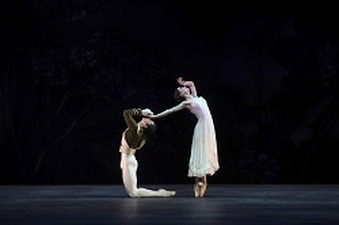
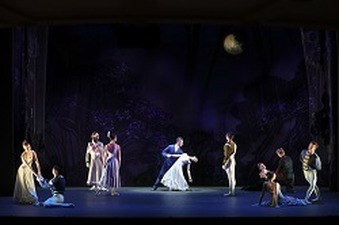
LILACS BLOOM September 29 to October 4, 2026 A bunch of lilacs thrust hurriedly into a young woman’s hand supplies the poignant denouement to Antony Tudor’s masterpiece, “Jardin aux Lilas,” a heartbreaker in one act that Sarasota Ballet performed at the Joyce Theater on September 29. Like so much in the divinely inspired “Jardin,” the ending is understated yet sensational. Hastily plucked at a garden party that is a scene of quiet anguish, the lilacs are a gift from the young woman’s Lover, whom she may never see again. He offers her this final token, before she turns to bid her friends adieu, her farewell gesture lingering hopelessly when it alights on her beloved. Then, a dark figure intercedes to claim her. Stiff with propriety, The Man She Must Marry folds her outstretched arm and leads our heroine away still clutching the flowers that symbolize her evanescent springtime. This brief dance has signaled the end, not the beginning of a debutante’s romantic life. The young woman’s name is Caroline. She is the only character in the ballet to have a proper name. Tudor defines the others by their roles in an Edwardian milieu where duty and, no doubt, financial calculations outweigh personal feelings. Those feelings are passionate, however, and what these party-goers attempt to mask with social graces, the ballet’s score, Ernest Chausson’s “Poème” for violin and orchestra, lays bare in lush and tremulous floods. Glances of darting suspicion, stealthy kisses, and handholds abruptly broken-off create an atmosphere of secrecy and unbearable yearning. In a famous gesture, Caroline attempts to compose herself smoothing the wrinkles out of her silken frock. Yet the light of a full moon, high above the garden, reveals the forbidden trysts that the protagonists are at pains to hide.
Emphasizing the lovers’ impossible situation, the choreographer often places Caroline or Her Lover behind each other. He appears suddenly from the wings and takes her unawares, her body thrilling as she senses his presence. Kneeling or lunging, he leans backward to kiss the hand she offers him from afar. In these positions, they cannot look into each other’s eyes, and, with their time together rapidly running out, their faces will become memories. They break apart just as the others are about to catch them, or ever so slightly too late. Whispers among the guests suggest we are not the only ones who detect Caroline’s misery. The Man She Must Marry has his own problems, in the form of a woman known as An Episode from His Past. While Caroline suffers passively, the Episode throws herself aggressively at her former beau, forcing him to catch her in lifts. She coldly spurns another man’s advances, yet at the end, when all is lost, she surrenders cynically to gaiety. In between their moments of stolen intimacy, Caroline and Her Lover find themselves awkwardly in the Episode’s company; and Caroline covers her face in despair, at the thought that her Lover may one day become the jaded woman’s prey.
While much of the action in “Jardin aux Lilas” is rushed, Tudor allows us to dwell on scenes of special poignancy, like the so-called “prayer to the moon,” when Caroline’s Lover and her friends make wishes at cross purposes, each wish cancelling out the others. In a celebrated tableau, Caroline swoons in her future husband’s arms, and while the company around her freeze in gallant attitudes, her spirit seems to leave her body dazedly seeking an escape. The appearance of a psychological breakdown marks this 1936 work as modern. The ballet’s wealth of expressive details and its split-second timing suggest Tudor’s punctilious nature, as well as his originality. Yet his concerns went beyond gesture. Dancers who worked with him recalled his insistence that they delve into their roles until they could imagine---and project---fully rounded characters whose lives preceded, and would continue after the actions depicted on stage. The dancers’ ability to create a world is the test of any production of “Jardin,” which Sarasota Ballet’s artists perform with delicacy and dramatic nuance. The opening-night Caroline, Marijana Dominis, adopts the softness of a woman easily bruised. She is a picture of offended innocence. Her psychic distress arises not only from frustrated affection, but also from surprise, as if for the first time her eyes are open to the world’s duplicity. Her Lover, Samuel Gest, appears callow and tormented. Ricardo Graziano brings a depth of human feeling to his role as The Man She Must Marry, creating an unusually sympathetic character who appears confused and overwhelmed, rather than angry. He remains icily determined. The Episode in His Past, Brooke Wilson, is admirably game displaying a flair for intrigue. The chance to see “Jardin” was enough to draw viewers to the Joyce, but Sarasota Ballet also offered a suite of exquisite miniatures choreographed by Frederick Ashton. This company does not have technicians on a par with Britain’s Royal Ballet, so viewers must temper their expectations. Yet the suite displayed the wonderful range of Ashton’s moods and his inventiveness, from the voluptuous acrobacy of the “Meditation from Thaïs” to the coquetry of “Les Rendezvous,” from the dreamlike Pas de Cinq from “Illuminations” to the ardent, yet playful Balcony Pas de Deux from “Romeo and Juliet.” The program concluded with Sarasota Ballet’s revival of Peter Wright’s “Summertide,” a divertissement notable for the second-movement adagio in which Dominis returns as Muse to Ricardo Rhodes and a pair of attendants who support and frame the ballerina in elegant, sculptural groupings. |