Robert Johnson
| DANCING
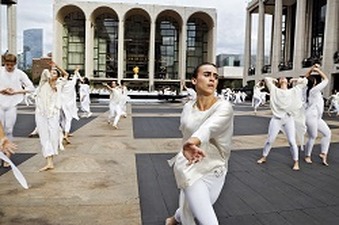
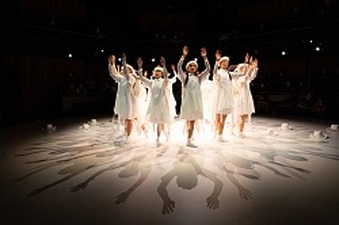
WITH TERRORISM, PART TWO Buglisi Dance Theatre in “The Table of Silence Project” Vangeline Theater/New York Butoh Institute in “Unforgotten: Butoh for 9/11” Choreographer Sarah Skaggs was among the first artists to leave the theater and go among the public with a response to terrorism. Her “9/11 Dance---A Roving Memorial” suddenly coalesced like a flashmob in Union Square, Washington Square, and Battery Park on the tenth anniversary of the Twin Towers’ destruction. Skaggs, who had witnessed the disaster from her rooftop in NoLita, called these 2011 performances “attacks of beauty,” and explained that her goal was to clear the atmosphere of the fear and suspicion that lingered in our public spaces long after the debris was hauled away. With dancers materializing suddenly in their midst, startled passersby would rediscover joy in their surroundings. That same year, choreographer Jacqulyn Buglisi launched the “Table of Silence Project,” a mass dance in which more than 150 “peace warriors” in white surplices occupied the central plaza at Lincoln Center for the Performing Arts. Reflecting a belief in the healing properties of ritual, and suffused with positive energy, the “Table of Silence” returns each year on the anniversary of the attacks. A non-sectarian observance everyone can join, this active prayer acknowledges the global impact of the tragedy with its variegated, multigenerational cast.
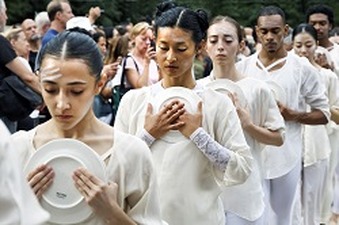
At the outset, six women in flaring skirts twist and thrash to Gabriel Fauré’s “Requiem.” Mounting stools, the women assume towering proportions in the manner of the soloist in Martha Graham’s “Spectre-1914,” as they beseech heaven and swoop in place. Accompanying them on an electric violin, composer Daniel Bernard Roumain performs a riff on “The Star-Spangled Banner.” A chaotic flock of individuals rushes onto the plaza, but at an appointed signal they drop to the floor together. When they rise, the dancers have become a community, and they begin to spin. The movements now suggest devotional calisthenics performed by a drill team. Making staccato gestures, the participants tread in circles around the central fountain animating the geometric design on the pavement, in which Buglisi discerns a sacred labyrinth. Simple, rhythmic gestures alternate with meditative stillness. Responding to further cues, the dancers vocalize wordlessly. As they bow and straighten, their hands flutter like the beating wings of a liberated spirit. Their garments conceal ceramic dishes, and reclining on the ground, they offer up these empty plates, symbolic peace vessels borrowed from an art installation by Rosella Vasta. Amid this celestial machinery, former Graham luminary Terese Capucilli wanders like a spirit guide.
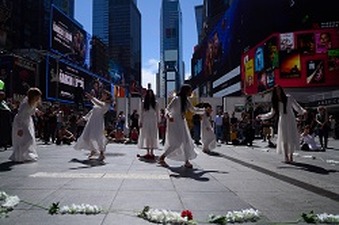
For the past ten years, another contemporary dance group, Vangeline Theater/New York Butoh Institute, has offered its own healing ritual in Times Square, bringing meditative calm to a space thronging with every kind of distraction. Below the steps of the sprawling TKTS stand, in the valley of flashing jumbotrons, where Minnie Mouse and King Kong waylay tourists and immigrants peddle handbags, seven women wearing white, summer dresses gather to perform Vangeline’s “Unforgotten: Butoh for 9/11” on the anniversary of the event. A border of white flowers marks the perimeter of a circle, with the dancers clustered at center. The women hold their bodies slightly bent, as supple as stalks. Their eyes are closed, and they lift their hands, just barely, as if to feel the breeze. This gathering could be another hustle, but something about the women’s stillness arrests the gaze of passersby and causes the heart to beat more slowly. They shift position so gradually that their movement suggests organic growth, and the viewer’s eye cannot discern the moment when one pose morphs into the next. These creatures appear to live in a state of nature that precedes consciousness, but not experience. Like plants, they have a different way of measuring time. Almost imperceptibly, the cluster of figures expands, and the dancers, who have been facing inward, now stand in profile.
Waves of calm seem to flow outward from the nucleus of the performance space, washing over the barrier of flowers and enveloping the audience. The dancers’ focus keeps us riveted, causing jumbotrons and car horns to vanish. Yet as the women begin to separate, gently staggering outward from the circle, notes of confusion and fear intrude. Suyi Xu sinks to the pavement and lies outstretched; and “Unforgotten: Butoh for 9/11” becomes a dance of mourning as one by one her companions lay a flower on her prone body, or place one in her hand. The time it takes to place the flowers suggests a lifetime of grief. Dani Cole, the final mourner, reaches skyward from a crabbed position, then, as her yearning subsides, she tilts and with infinite resignation her body seeks its resting place. Thus, we will all dissolve one day. Among the choreographers who have sought an answer to 9/11, a basic difference in attitude divides those like Donald Byrd, who record the emotional trauma, from those like Buglisi and Vangeline, who would offer comfort. In Randy James’ “A View from the Hudson,” performed at the John Jay Theater in 2002, a woman struggles to forestall the inevitable, ineffectually pressing against another dancer’s chest as he advances. The piece is filled with images of flight and paralysis, of individuals oppressed by physical and mental burdens, of stifled cries and nervous tics. Anger and hysteria sound the dominant note in Keely Garfield’s “Deep,” also created in the aftermath of the tragedy, and presented at the Joyce Theater in 2002. In this dark comedy, Garfield skewers the power relations among a cast of cartoon characters and rails against a world turned upside-down. Still other artists have exposed the crimes of our national security state in the wake of 9/11. Jane Comfort had to self-produce her scathing reality-show satire “An American Rendition,” at the Duke on 42nd Street in 2008; while composer Laurie Anderson created a monumental spectacle on the same theme, featuring a holograph of abductee and torture victim Mohammed El Gharani in her piece “Habeas Corpus” at the Park Avenue Armory in 2015.
Twyla Tharp, however, felt herself propelled in another direction. While the Towers were still burning, the thought of the initials WTC led her to her music collection, where she selected a recording of Bach’s “Well-Tempered Clavier.” The choreographer located a Higher Power in Bach’s musical genius and his ability to fashion an orderly world. After much reflection, Tharp poured her energy into creating “Preludes and Fugues,” a masterpiece in its own right. A single episode in this 2015 work, danced at the Joyce, acknowledges our psychic trauma. The other portions celebrate love, faith, and diversity, with circling references to Bach’s “circle of fifths,” cross patterns, and subtle allusions to great figures in the history of American modern dance. Tharp’s response to 9/11 was to re-affirm a belief in Providence, and in the discipline of daily practice. When the Perelman Center for the Performing Arts opened in 2023, as the capstone of an effort to rebuild the neighborhood around Ground Zero, the inaugural season featured a trio of intriguing postmodern dances grouped under the heading “The March.” Perhaps the event’s organizers were counting on the abstract nature of dance to deflect potential references to the history of the site. Among the choreographers who participated, however, Annie-B Parson still managed to produce a dance with a political subtext. Her piece, “The Oath,” seemed to invert the message of solidarity inherent in “The Table of Silence Project.”
In “The Oath,” unison movement suggests submission and conformity, not collective strength. Outfitted with symbolic accessories like cowboy hats and chaplets of flowers, the white-clad celebrants in “The Oath” march and wheel in regimented lines. Mindlessly they tread upon one another and perform gestural incantations. Steps away from Memorial Plaza, and the pits that mark the hollow footprint of the Twin Towers, “The Oath” courageously denounces both religious zealotry and jingoism. What no dance artist has managed to do yet, however, is question the official narrative surrounding the terrible events that demolished 16 acres of Lower Manhattan. Perhaps unwittingly, the architecture of the Perelman Center comments disquietingly on those events and on the state of our society. Perched on the edge of a heavily surveilled memorial park welcoming only to tourists, the theater overhangs the site of the tragedy like a dazzling enigma. Its translucent stone sheathing gleams softly, wrapping the building in mystery and suggesting concealment. Something extraordinary is happening inside, but what? In an age when “accessibility” has become a shibboleth, the theater lobby can be gained only by climbing a black, stone staircase, or riding a hidden elevator. The interior is equally mysterious, a warren of inky backstage corridors and walls that can be reconfigured to accommodate artists, but leave the public confused and dependent upon assistance. While our dance artists choreograph rituals, lamenting or serenely affirming their faith in the future, this tantalizing but secretive building is the ultimate monument to 9/11---a Pandora’s box that simultaneously tempts us and warns us not to enter. |