Robert Johnson
| THE
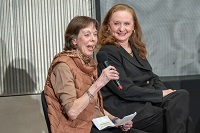
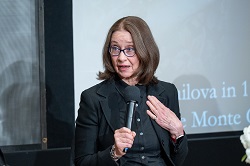
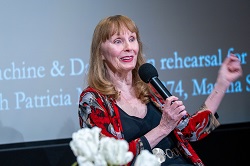
MANY LIVES OF ALEXANDRA DANILOVA April 20, 2026 For Alexandra Danilova, dancing was an art of style and fascination. As prima ballerina of the Ballet Russe de Monte Carlo, she bewitched theater-goers with her quicksilver movement and infectious gaiety. As a teacher at the School of American Ballet (SAB), she enthralled students with her glamour. Wherever she went, Danilova [1903-1997] turned heads and left an aura of charm. That Danilova was also a hawk-eyed coach, and a tireless worker was never in doubt. Her casual manner and sense of fun concealed an obsession with the stage. With the final words of her autobiography, she renewed her profession of faith, and underscored her priority in life: “I gave one hundred percent of myself to my art,” she wrote, “and my art has repaid me.” Apart from her generosity and kindness, students adored Danilova because they knew she shared their youthful passion for dancing. She never grew jaded. A handful of Danilova’s disciples gathered on April 20 to remember the legend familiarly known as “Choura.” Organized and led by dance historian Elizabeth Kendall, “The Many Lives of Alexandra Danilova” was hosted by the New York Public Library for the Performing Arts, and sponsored by the George Balanchine Foundation. The symposium, featuring films and images from the library’s Dance Collection, brought together former New York City Ballet principals Maria Calegari and Patricia McBride, and dance journalist and teacher Kim Kokich, all Danilova’s students. Kokich, in addition, is Danilova’s goddaughter, her father being the ballerina’s ex-husband, Kazimir Kokich.
Calegari, who exuded her own, unforgettable perfume on stage, spoke with characteristic modesty of Danilova’s allure as she prepared her talented student for the SAB Workshop. “We’re just Americans,” Calegari said. “I’m a girl from Queens.” Danilova, au contraire, had danced with the ballet company of the Mariinsky Theater in pre-Revolutionary St. Petersburg, and afterward had joined the final flowering of Diaghilev’s Ballets Russes in Europe. In New York, she danced on Broadway, as well as with the Denham company. Her theatrical experience was unmatchable. Perhaps the most amazing facet of Danilova’s art is the way she preserved the recognizable outline of her classical schooling through a variegated career that demanded flexibility and exposed her constantly to innovation. Always impeccably dressed, Danilova taught her charges to present themselves as ballerinas, onstage and off. In rehearsal, she urged them never to “mark” a step, but to dance full-out. To Calegari, she explained the phrasing of the “White Swan” variation from “Swan Lake;” and how to make steps legible to the audience. “Even if there’s no story there’s a story,” Calegari said. Most of all, Danilova gave her students courage, a sense of gravitas, and grandeur. Calegari recalled her teacher’s soulful eyes and the tilt of her head; and lifting her fingers, demonstrated the ethereal gesture from the “Prelude” in “Les Sylphides.”
Kokich had a more intimate relationship with the ballerina, whom she used to visit at her dacha, in Lakewood, New Jersey. Like other Russian ex-patriates, Danilova had survived life-altering disasters. She knew the taste of fine champagne, but also the pinch of hard times. According to Kokich, Danilova’s fellow refugee, George Balanchine, rescued her from penury in a dingy, midtown apartment, when he hired her to teach at SAB. Yet Danilova never complained. Kokich recalled her as adaptable and pragmatic, setting an example of elegance and emotional strength. Kokich also recalled Danilova’s sense of humor, which could be endearingly self-deprecating. Kokich said that when she teaches now, she hears Choura in her head. “It’s always about nuance,” Kokich said. “Coppélia” was the focus of discussion for McBride. The ballet’s protagonist, Swanhilda, would become a signature role for her. McBride first danced “Coppélia” as a guest with Tulsa Ballet Theatre, in 1964, and repeated her success in 1974, when Danilova assisted Balanchine to stage his own version for New York City Ballet. Danilova coached McBride both times, and she recalled that the elder ballerina demonstrated every step in ’64, and still danced full-out ten years later. “How” one put the steps together was as important to her as the choreography itself, McBride said; and undoubtedly the stylish Danilova saved McBride from playing the part as a soubrette. Since then, the role has been cheapened. Paying tribute to her mentor, McBride said, “She brought joy to everyone who worked with her.”
Danilova was also lucky to live in an age when her dancing could be captured on film. In her duet with actor Tony Randall, from the 1953 Broadway show “Oh, Captain,” the ballerina displayed beautiful phrasing, mercurial speed alternating with lyrical gestures that filled out the music. Naturally, her personality sparkled. A later video of her teaching similarly emphasized dynamics, as Danilova showed her students how to perform without wasting energy or space. Though no stranger to frou-frou, perhaps Danilova’s campiest role was the part of the Russian ballet teacher Madame Dakharova, in the 1977 film “The Turning Point.” An excerpt from this Hollywood production found Danilova chirping cheerfully at the dinner table while ladling borscht; though amusing, if would have been better to show the wonderful footage of her épaulement coaching Leslie Browne in the ballet “Don Quixote.” That brief scene was unforgettable. Of course, no portrait of Danilova would be complete without a vision of her as the Glove Seller swept off her feet in Léonide Massine’s effervescent “Gaîté Parisienne.” In that sentimental fantasy, a generation weary of war found solace in a ballerina’s unquenchable love of life. |