Robert Johnson
| Mark
Morris Dance Group at 40: Waving the Flag July 14-25, 2026 A prolific choreographer, Mark Morris must have scratched his head while planning his company’s 40th-anniversary season. A single season could never do justice to the generous output of 40 years; and the Joyce Theater could not accommodate his largest pieces. His brilliant solution was to frame the Mark Morris Dance Group’s Joyce engagement, July 14-25, as a celebration of American music. Jingoism, however, was hardly the point. As we observed the 250th anniversary of American independence, Morris seemed determined to probe the nation’s psyche, and the roots of our culture wars. The variety of musical styles and genres represented on three separate programs prompted viewers to question who we are as a people, and how our music defines us. Throughout the season, versatile pianist and music director Colin Fowler added immeasurably to the performances, along with all the members of the Mark Morris Dance Group Music Ensemble, appearing live. Morris’ musical selections not only revealed this country’s diversity, but also pointed to its divisions. Jazz pianist James P. Johnson, country-western crooner T. Texas Tyler, and cutting-edge modernist Henry Cowell were all Americans, yet they inhabited different musical worlds. They represented disparate communities, and wrote for their own audiences. How strange to think that the post-modern imagination may be the only place in this vast land they truly cohabit.
“Pizzica” opened Program A, subtitled “Soul of America---Jazz and Pop.” This new piece harks back to Morris’ early interest in folk dancing. The choreographer is entirely at his ease staging a tarantella---too comfortable, perhaps---and while the piece contains the usual campy flourishes, its humor may be too discreet to compensate for its simplicity. At the outset, Joslin Vezeau feigns spider-bite convulsions; and the vocabulary includes a stereotypical Italian hand gesture with thumb and fingers pressed together. Romantic disillusionment mars the joyful atmosphere when Karlie Budge wipes an unwanted kiss from her mouth. Yet, for the most part, “Pizzica” remains a straightforward exposition of folk-dance steps, which are more fun to do than to watch. Inevitably, viewers will compare this thin effort with the virtuosity of George Balanchine’s “Tarantella,” set to the same, Louis Moreau Gottschalk score. The same criticism could be leveled at “You’ve Got to be Modernistic,” to music by James P. Johnson, where swinging ropes of pearls, and the knee-wagging steps of the Charleston appear all-but naked. Before too long, the dance’s cheerfulness begins to pall. Contrast Morris’ spare approach, focusing on the steps, with Paul Taylor’s elaborately theatrical treatment of Ragtime in “Oh, You Kid.”
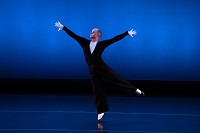
Theatricality is key to some of Morris’ finest works, however, encompassing both the gentle emotional coloring of “Three Preludes,” and the ribald humor of “Going Away Party.” The effects need not be strident. Although Dallas McMurray has his carefree moments, his dancing in the solo “Three Preludes,” to Gershwin, exudes wistfulness. His hands, flicking and curling, suggest a brave attempt to ward off despair. Buoyed by the rhythm, McMurray also seems oppressed by it, tilting off center and slumping. He pulls his fists apart and seems to lift them in protest, only to spin out of control and be blown off course. Though the sprightly finale rescues him, we can’t forget the revelation of the Andante, and Isaac Mizrahi’s elegant, two-tone costume, accessorized with white cotton gloves, suggests more than ebony and ivory piano keys. In a country still burdened by racism, this marvelous blues solo goes straight to the heart. Morris is not always so subtle. “Going Away Party” offers the brash hijinks of an old-time polka party complete with dancing cheek-to-cheek, arm nibbling, and butt slapping. Raunchy sight-gags and gestures borrowed from every-day life complement the bouncy steps and ballroom patterns. The men make pit-stops upstage, zipping up their flies as they turn back to face us; and the women apply lipstick. In an astonishing lift, the men bury their faces in their partners’ skirts making the women squirm with pleasure. Meanwhile, Bill Wills and his Texas Playboys sing, “To feel your lips on mine, just like the old times/baby, that sure would go good.” So much for “pure” dance.
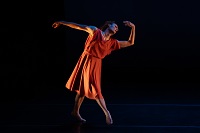
For all its naughtiness, this romp also has soul. Billy Smith, the character associated with the title song, is never so lonesome as when the group emerges from an upstage corner buzzing with their own intrigues, and blind to his existence. Smith thinks he sees a friendly face and waves, but, naturally, she was waiting for someone else. After the bus has left for Amarillo, it will be his job to turn off the lights. Does it make “Going Away Party” less humorous, or slight Morris’ compositional sleight-of-hand, to point out that what most endears this dance to viewers is its note of wry human sympathy? Sweetly satirical, “Going Away Party” lets us off easy, concluding Program B on a cheerful note. The first portion of this program, however, subtitled “American Heartbeat---Country and Western,” leads us to the edge of a cultural chasm. Few people in the urbane audience at the Joyce, we can guess, can relate to the mawkish piety of T. Texas Tyler’s spoken-word recording “Deck of Cards,” which tells the story of a poor soldier whose cards remind him of his Bible lessons. Conversely, few of that recording’s devout admirers would be likely to enjoy Morris’ gender-bending treatment of George Jones’ ballad “Say It’s Not You.” Morris’s response to Jones’ waltz of heartbreak is a blowsy solo in which cross-dressing Billy Smith is the “girl who spreads love around.” Flitting in a broad circle, Smith seems to pursue romance in earnest, and when exiting with his face hidden in his hands, the gesture telegraphs disappointment as much as shame. Dallas McMurray is the misunderstood hero of “Deck of Cards,” his gestures stiff and constrained, his shoulders twitching, and his dancing increasingly hectic as if this man were on the verge of a breakdown. Morris takes McMurray’s character seriously, but provocatively shows him half-clad, wearing a neatly pressed dress uniform and boxer shorts.
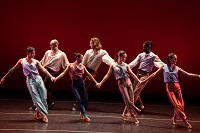
Religion is even more of a bugaboo in “Songs That Tell a Story.” This folksy trio featuring Brandon Randolph, Christina Sahaida, and Joslin Vezeau is set to the twanging harmonies of the Louvain brothers, Ira and Charlie. (Ira Louvain was one of those rip-snorting old boys who found no contradiction between hymn-singing and riotous living.) The song “I’ll Live with God (to Die No More)” is sweet and lively by turns, rejoicing at the thought that life’s trials are nearly over; while “Insured Beyond the Grave” suggests a wacky sales pitch for salvation. The mood turns ominous, however, in songs that make eschatological excuses for war. When the Cuban Missile Crisis threatened to incinerate millions, in 1962, the Louvain brothers released an album featuring “Robe of White,” in which a pathetic old mother consoles herself with the thought that her dead soldier has earned a heavenly reward. “The Great Atomic Power” is even scarier, enthusing over the prospect of the End Times, when the saints will rise from radioactive puddles to meet Jesus. With Mike Huckabee currently U.S. ambassador to Israel, this attitude should give us all pause. Flamboyant parody would not be amiss here, although no one could ridicule a mother’s grief. Morris satisfies himself, however, by undercutting the music’s pathos with slick, affectless moves that emphasize the rhythm. Stylized one moment, and literal the next (the dancers mime the lyrics with trembling hands and draw the outline of the mother’s doorway), the choreography of “Songs That Tell a Story” arguably does not do enough to skewer the Louvain brothers’ lunacy. Where is Woody Guthrie when you need him? Someone once said that American culture is popular culture, yet, like it or not, this country also has its aesthetic high-brows. Morris could not leave us without pointing out that the real “mavericks” of American music are not cowpokes serenading the herd, but the avant-garde composers who gathered around musical guru Henry Cowell. A son of the Bohemian West, Cowell was a free thinker and a genuine pioneer. The fact that his name is less familiar than, say, Aaron Copland’s tells us more about the cultural divisions in American life---the sectionalism pitting East against West and the South against all, the homophobia, and the bias against artists and intellectuals. The late historian Richard Hofstadter has pointed out that this bias is a complex phenomenon, reflecting a democratic and antinomian distrust of elites. “Program C: American Mavericks---West Coast Composers” is the real gem of the season, however, for those who take modern dance seriously. “Prelude and Prelude,” to Cowell’s “Set of Two for Violin and Harpsichord,” relies upon a bold, compositional gambit. In the first half, Robert Rubama emerges from a line of dancers arrayed along one side. Roaming through the open space, Rubama passes through a series of monumental poses. Though his movements may be abrupt, the music lends these evolutions a satisfying, dreamlike quality; and the poses flatter his gorgeous figure. Meanwhile, the dancers lined up on the side manipulate fans. The fans conceal their mouths and crotches, and toggle front-and-back to reveal different colors. In the second half, the soloist and the ensemble switch places, the group filling the space with a staggered, broken-up version of Rubama’s solo while he takes up his fan and dances their part alone in the corner. The effect of this simple design inversion is breathtaking.
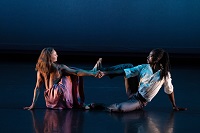
In “Jenn and Spencer,” set to Cowell’s 1925 Suite for Violin and Piano, we hear what all the fuss was about. Cowell courted outrage with his piano-bashing Expressionism, even when he coupled it with a lyrical, melodic line. In 2015, Morris borrowed Cowell’s thunder to create a raging, passionate encounter between two dancers, who begin circling the stage brusquely, one hand raised as if to strike. We all know couples like this. Karlie Budge and Brandon Randolph move with an ever-present tension, ready to explode. Yet while their encounters are confrontational, they are also tender, intricate, and supportive; and Randolph is not above laying himself at Budge’s feet. A worthy sequel to Balanchine’s “Duo Concertant,” this magnificent pairing is just as intensely human but stripped of sentimentality. In his 1995 “Pacific,” created for San Francisco Ballet, Morris seems more interested in the dance’s formal structure than he is in capturing the plaintive appeal of Lou Harrison’s Trio for Violin, Cello and Piano. The dance proceeds coolly to integrate three separate groups of dancers: a male trio, a female quartet, and a mixed duo, their costumes conveniently color-coded. Gestures and rhythmic accents seem decorative, rather than expressive; and while the dancers’ stretched lines are undeniably beautiful, and the lyrical movement highlights the particular gifts of Brandon Randolph and Joslin Vezeau, “Pacific” remains an elegant divertissement.
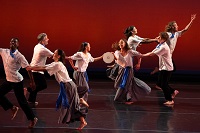
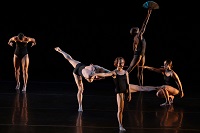
The stupendous “Grand Duo,” to Harrison’s “Grand Duo for Violin and Piano,” has more punch. Reflecting Harrison’s interest in gamelan music, the choreographer brilliantly abstracts the flatness and sinuosity of Balinese dance. On a shadowy stage, flattened lines of dancers with elbows out recall a string of paper-doll cutouts. In a prominent, recurring gesture, a dancer tests the air with circling fingers, as if sampling an invisible substance and ready to experience a new flavor. The dialog between piano and violin lends itself to oppositions of various kinds. Lines of dancers face upstage and downstage simultaneously, and the cast splits into two groups that confront each other on a diagonal. More significant than the structural complexity of “Grand Duo,” however, is the work’s emotional depth. Slapping, bouncing, and jabbing rhythms make some passages seem light-hearted, while other sections seem drenched in an air of mystery and sadness. Unison movement conveys a powerful sense of solidarity and group identity, yet individuals can also be seen winding their way across the stage, following their own paths or drifting apart from the group. In an especially poignant moment, Joslin Vezeau sits isolated on the floor outside a circle of dancers, her head acknowledging a rhythm that the rest of her body seems unable to obey. Harrison’s music couldn’t be more different from that of Bill Wills and his Texas Playboys, but despite the altered context, Vezeau’s isolation recalls the plight of the lonesome cowboy in “Going Away Party,” not to say the plight of everyone in this country who, for one reason or another, feels himself to be an outsider. Some of our fellow citizens only listen to one kind of music, and have a narrow idea of what it means to be American. For others, humanity crosses boundaries and our country’s strength lies in its diversity and openness to the world. For those people, Mark Morris’ anniversary program is so American you can taste the apple pie. |