|
LOVE
CONQUERS ALL IN AMERICAN BALLET THEATRE’S “SYLVIA”
Choreographer Frederick Ashton points the way forward
by refreshing ballet tradition.
July 9-11, 2026
Metropolitan Opera House, Lincoln Center for the Performing Arts,
Presented by American Ballet Theatre
Thurs.-Fri. at 7:30 p.m., matinees at 2 p.m., Fri-Sat.
Tickets are $32 to $388. Call the Box office at (212) 362-6000, or
visit abt.org
Reviewed by Robert Johnson on July 11, 2026
When he choreographed “Sylvia” in 1952, Frederick Ashton
gave new form to the past. The ballet’s score by Léo
Delibes dictated that Britain’s premiere neo-classicist would
take inspiration from 19th-century models like “The Sleeping
Beauty.” Its libretto led him further back in time to a Renaissance
pastoral, Torquato Tasso’s “Aminta.” American Ballet
Theatre’s glorious production of “Sylvia,” seen
July 11 at the Metropolitan Opera House, is all the more precious
for the fact that young choreographers today are not heeding its example.
The lesson of “Sylvia,” if only we would learn it, is
that ballet’s future depends upon extending Western tradition.
In “Sylvia,” Ashton blends narrative fantasy and stagecraft
with a fluent use of classroom steps. As in “The Sleeping Beauty,”
supernatural characters disguise themselves, cast spells, and effect
magical transformations. A vision of the beloved appears behind a
gauzy scrim; and transportation is by enchanted gondola—no fare
required. A flower changes color before our eyes, and, in the right
hands, it has the power to revive the dead. A wealth of supporting
characters people the stage (Naiads and Dryads; Fauns and Sylvans),
and designers Robin and Christopher Ironside have not been shy about
handing out props. Someone backstage is very busy untangling garlands,
stacking farm implements, and counting wheelbarrows, baskets, and
archery equipment---and that’s just in Act One.
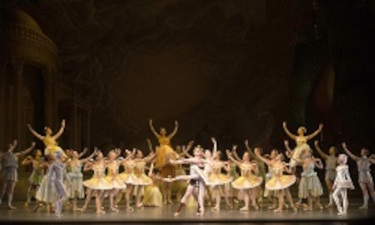 |
Aran Bell and Hee Seo with
the cast of “Sylvia.” Photo by Nir Arieli. |
Ashton is just as generous in doling out steps, displaying
a wonderful sense of rhythm and line. The shepherd Aminta’s
first-act variation is remarkable for the way it displays the dancer’s
chiseled legs. Ashton gives us not just the soulful arabesque turn
we might expect, but also a step through high relevé into a
pulled-up, fourth-position pose, and later a straight-legged turn.
Perhaps the choreographer was remembering the taut definition of the
Blue Girl’s legs in “Les Biches,” though a little
twist accentuating that fourth-position pose now seems to be missing.
In any case, Aminta’s admirers could wish for nothing better.
His first-act solo seems to anticipate the wonderful enchaînement
in Act III, when Sylvia’s attendants descend from the magic
barque and scoop sharply pointed feet to the knee in high pas de bourrées.
Sylvia’s role is packed with finicky pointework and opportunities
to display her feet, the steps repeated on both sides with unforgiving
symmetry. In Act One, we pass from the bold dancing of the Hunt attendants,
who cavort with lusty balloté-ballonné jumps, to the
petit allegro of Peasants who briskly skim the ground. Ashton loves
small, quick steps that demand exceptional clarity. Throughout the
ballet, tricky changes of direction, and leaps with no preparation
challenge the dancers’ virtuosity. Dramatic plot reversals and
changes of atmosphere make Sylvia’s role, in particular, a test
of the ballerina’s expressive talents. Beside her multi-faceted
character, the men are mere foils.
Delibes’ overture offers tantalizing previews of the adventures
to come, with passages suggesting mystery and longing, danger and
excitement. Yet the ballet’s pastoral setting restrains the
drama, limiting it to a poetic temperate zone. This is ballet in anachreontic
mode, and though the brutish Orion abducts Sylvia, who theoretically
risks “a fate worse than death,” there is nothing here
that compares with the emotional ravishment of the lovers’ suicides
in “Romeo and Juliet,” or with Giselle’s madness
and death. At most we feel a vague unease, as Sylvia schemes to escape
from Orion’s lair. Though three characters are shot with arrows---“straight
through the brisket,” as the crime writers say---those characters’
worst torments stem from unrequited love. Sylvia is only helpless
in the face of her own, melancholy obsession. Eros arranges everything
to his liking, and even his fellow deity, Diana, must bow to his all-conquering
authority.
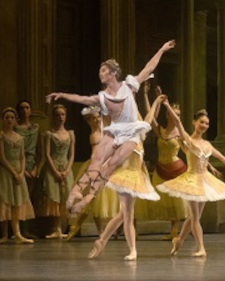 |
Takumi Miyake as Eros in
“Sylvia.” Photo by Nir Arieli. |
ABT has fielded more powerful casts, though Hee Seo
makes a favorable impression with her lyricism and femininity. Setting
aside Sylvia’s martial helmet, and the brusque manner of her
entrance, Seo becomes a vision of loveliness bathing by the fountain
in Act One. Shaking her bow threateningly at the statue of Eros, she
rages fanatically; and appears relieved when Eros’ arrow pierces
her without doing harm (it takes time for love’s poison to work).
Seo’s acting is vivid throughout. Held prisoner by Orion, she
regards his gifts with sad indifference. Then, her eyes sparkle with
intrigue as she conceives her plan of escape, and she leads the camp
in lusty and intoxicating revels. When winged Eros turns up to admire
his own handiwork, Seo’s infatuation is piteous to behold.
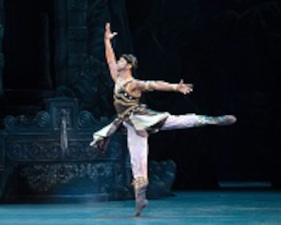 |
Jose Sebastian as Orion in
“Sylvia.” Photo by Nir Arieli. |
As Aminta, brawny Aran Bell still lacks refinement;
and Jose Sebastian is a wooden Orion. The part of Eros suits Takumi
Miyake, who has a chance to show off his bravura leaps in Act Three.
The divertissement remains a vision of high-flying gaiety, though
it could be better rehearsed. Léa Fleytoux and Tyler Mahoney
display marvelous synchrony as a pair of comic-book goats; and Fangqi
Li seems to bring her own light with her on-stage, dancing with admirable
clarity as an energetic and meticulous Terpsichore. David LaMarche
conducted the orchestra with his usual panache.
|