
Glenda
Frank
“An American Daughter” by Wendy Wasserstein returns Directed by Sarna Lapine and produced by La Femme
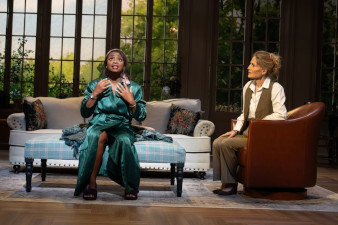
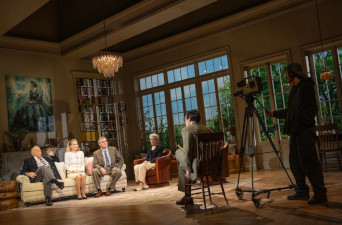
Theatre Productions The first New York City revival of “An American Daughter” (1997) by Wendy Wasserstein now at the Signature Theatre Center, produced by La Femme Theatre Productions, boasts a female protagonist, female author, and female director. Lyssa Dent Hughes (played by Jean Lichty, Executive Director of La Femme Theatre Productions) is a nepo baby -- daughter of a senator and the fifth-generation offspring of Ulysses S. Grant. She has it all: a picture-book family, close friends, a career as a renowned physician and now a nomination to become Surgeon General of the United States. Timber Tucker (Chris Ghaffari) is going to interview her, but as his promised puff piece turns into an exposé, she finds herself on the losing end in the realms of public opinion and politics.
I was excited by the opportunity to see if the play has aged well. What struck me in this production was play’s deep thematic cynicism. Lyssa is betrayed by both American culture and the people she thought would surely support her. During the interview, her husband, in praising her abundant energy and almost selfless dedication to women’s health, mentions that she did not report for jury duty. Her children were ill, the nanny had vanished, she was running a hospital, and somehow the summons was misplaced. This might have been cast as a bad moment in the life of an overachiever, but her “friend” Morrow (Ryan Spahn), a journalist, kept harping on it so that Tucker, even if he had chosen to, could not ignore the fact. It soon overshadowed her many achievements. Why did Morrow do that? One explanation is that as a competitive journalist, he’s trained to probe revelations. He couldn’t distinguish between his professional life and private persona, between a knee-jerk focus to gain readers and friendship. Or maybe there’s something toxic in our culture. He’s not the only one to betray Lyssa. Feeling neglected, Walter (Robert Sean Leonard), her husband, is tempted by Quincy Quince (Carmen Zilles), a former student whose feminist work has landed her on the list for top achievers under 30. There are hints, as there are in other Wasserstein plays, that there’s a generational battle, but Quincy, for all her ambition, comes across as a potential ally. ( I wish Zilles (“Dog Day Afternoon”) had found the right attitude to make this interesting role hers.)
But what shocks Lyssa the most is the reaction of the anonymous women of America, who resented her offhand comments about her mother’s ice box cake. Poll after poll indicated Lyssa as a negative role model. Today she’d ride through, spinning a new narrative, but Lyssa resigns. The events informing the play have their own dramas, and they should inform the tone of the production. Audiences should walk away roused, even indignant at the disrespect. Back in 1992, Nannygate was front-page news. The two highly accomplished women that President Bill Clinton nominated for Attorney General were disqualified. Corporate lawyer Zoë Baird hired an illegal alien and did not pay for her Social Security. Federal Judge Kimba Wood had also hired an illegal immigrant, which was not unlawful at the time, and did pay for her Social Security, but the disclosures were enough to disqualify her. Even more chilling was the parallel with a Hillary Clinton interview after she confessed that she had no time to bake cookies. Clinton, working full time at the Rose Law Firm while raising her daughter and fulfilling her obligation as the wife of the governor of Arkansas, thought it a frivolous question, but she was seen as elitist, out of touch with the women of America. Her comment -- “I suppose I could have stayed home and baked cookies and had teas, but what I decided to do was to fulfill my profession” – has now become a feminist meme. (Family Circle Magazine, capitalizing on the furor, invited Clinton and Barbara Bush to post competing cookie recipes. Clinton won the contest but was criticized for not using butter in the batter.) Has the play aged? Of course. It’s a creation of its time, but the issues of female empowerment and friendship still reverberate. Chekov’s plays mirror a world of social upheaval in Russia. Dress Shakespeare any way you want, but the 17th century still peeks through. Arthur Miller? Willy Loman would have filed an age-discrimination suit or applied for Disability. Maybe An American Daughter hasn’t aged enough. Should you see it? This is a flawed production. Some problems – like the faulty acoustics -- are obvious from the first few scenes. In the last few rows of the Irene Diamond stage, dialogue is sometimes lost, words swallowed. The cast must have known about the problem because Robert Sean Leonard, Dakin Matthews as the senator and Mary Beth Peil as his charming fourth wife were very careful to articulate clearly and in a loud voice. They were so good that the roles for these three stage veterans seemed tailor made for them. My friend, who usually wears a hearing aid, had major problems so at the end of Act I, she rented a hearing device, which did not work. She complained and was told that many people were having the same problem. The theatre is working on it. The production felt long. The play seemed talky, with too few fireworks.
The conflicts needed to flash, not flicker; tensions needed to push
and pull us; and Quincy’s sexuality, which she used as an
asset, needed to sizzle, not burp. Signs of life from the living
performers make the stage a better place. Wasserstein, famous for
her comic zingers and timing, sometimes underwrote, leaving room
for gifted performers to find the nuances, just as Montego Glover
did. Even her pauses were dramatic. She deserved the best line in
the play, its theme in all its comic coloring. She enters Lyssa’s
living room dripping wet from a mishap in the Potomac River where
she “rescued” a box of donuts. She had a revelation,
her mother’s favorite saying: She gets to say it twice. [GF] |

| recordings | coupons | publications | classified |