Dorothy Chansky
|
Miriam Silverman Leads a Spirited “The Verge” In Fiasco Theater’s revival of Susan Glaspell’s unsettling drama, Miriam Silverman embodies an artist’s fierce revolt against convention. October 27 to November 29, 2026 Audrey II of "Little Shop of Horrors" was not the first plant to have a crucial role in an American play. That honor belongs to a potted original named Breath of Life, who appears in Susan Glaspell’s 1921 play "The Verge". (Her "Inheritors" was also first presented in 1921.) Glaspell co-founded the storied Provincetown Players with her husband, George Cram Cook. While fellow Provincetowner Eugene O’Neill has greater brand recognition these days, Glaspell’s work more than holds its own, especially in the hands of an inspired and innovative team of actors and designers, which "The Verge" can boast in the current Fiasco Theater production being offered at the Public.
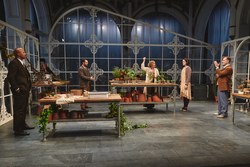
Breath of Life shares the stage with a somewhat less impressive botanical named Edge Vine, which is destroyed by its creator at the end of Act I. That creator is Claire Archer, an upper-class amateur botanist whose name, like much else in this script, seems at first blush to be overdetermined, although categorizing the play as partially expressionistic mitigates that a bit. Claire seeks clarity and she takes aim at convention. The men in her life are Tom, Dick and Harry, who are, respectively, her soul mate, her current lover, and her husband. While Harry captivated Claire on account of being an aviator, he has proven a flat-footed bastion of predictability rather than a partner who could take her to great heights, leaving her bored, unfulfilled, and more restless than ever. (Remember the old joke about wanting three things in a partner: help around the house, the ability to cook, and an interest in sharing feelings. The key is that these three people should never meet.) Claire (played with spunk, intelligence, and more than a little obstinacy by Miriam Silverman) wants to sever ties with what exists and she values a “capacity for madness.” If she can achieve a break with the past via plants she won’t have to do it to herself. Claire’s utterly prosaic daughter Elizabeth (Amara Leonard) can only imagine the work with plants taking place in the name of some kind of betterment, but Claire tells the uninteresting offspring that she cares not whether her plants are better—only that they are different. (She attacks Elizabeth with Edge Vine’s dead branches before trashing them.) Difference is not on the menu for either the daughter, who has just returned from a European sojourn supervised by a chaperone only identified as “Miss Lane,” nor for Claire’s sister Adelaide (played by Emily Young, who also doubles as a housemaid). Both these women, as well as husband Harry (a worried and utterly convincing Noah Brody) would prefer that Claire give up her experiments, show up on time for dinner, and go to church. Although Claire has no use for Elizabeth—who is now deemed “finished,” since she has graduated from whatever institution for upper-class girls was her family’s choice (her aunt Adelaide seems to be the responsible one) for her—she (Claire) remembers with fondness and approval the son who died at age four. His curiosity about the universe made him, in her eyes, both an ideal human and unfit for life as his family knew and practiced it. Director Jessie Austrian, a co-founder of Fiasco and also partner of actor Brody, has culled compelling and entirely credible performances from her entire cast (overdetermined script or no, all are “relatable”), although Silverman has the heaviest lifting to do. Claire feels imprisoned and is trying to reach through to what she doesn’t know is there. Silverman captures the straitened circumstances that define her world; she also conveys her passion for both her work and for Tom (Paco Tolson), whom she both wants as a lover and with whom she wants a relationship defined by spiritual oneness and unsullied by sexual relations. In the end she murders him. Breath of Life comes into its own on its appointed day and appears in glowing green for all to see. But after the murder the green turns red. (Props are by Caitlyn Murphy.) Although Claire has confessed to being tired, lonely, and afraid, and although Tom has promised to keep her safe, she refuses to be held by anyone. Is Claire crazy? When she recites some words from “Nearer, My God, to Thee” in a final tableau, is it a private God to whom she is reaching or has she been recuperated by her cosseted world? Director Austrian’s design team help facilitate the present-day believability that the actors achieve. Period costumes (by Sarita Fellows) neither impede movement nor call attention to themselves (although Adelaide’s drop-waist dress had me longing for one in my size). Lawrence E. Moten III (sets) has created a greenhouse and upper tower that are pretty, workable, and manage to seem all part of one house (at one point there is the hint of a dining room in the background, too) without necessitating a lot of stagehands or machinery to shift locales. White lighting (Amith Chandrashaker) contributes to both the sense of snowy cold and to the purity Claire seeks. Glaspell’s text is an obvious feminist cri de coeur. It is also a fabulous vehicle for a tour-de-force performance in the hands of the right female lead. Silverman is that lead. |