
|
Beate Hein Bennett
Dreams
of the Past – Dreams of a Future "Blooming in Dry Season"
Those of us who live in the cold hard North Country imagine the Caribbean islands as the tropical paradise that the tourism industry and airline marketing project with images of sun, sea, and palm trees, pulsating marimba music and delicious seafood feasts. Often the images are devoid of the people who live there, most of them eking out a subsistence by fishing or serving the tourism industry. The sounds of Harry Belafonte, Bob Marley, the Buena Vista Social Club and others may transport us outsiders to an exotic world that has little to do with the reality of life for the people who have made their home on these islands for centuries. Some are the descendants of African slaves, some are descendants of the colonizers, some are indigenous, and most are a mix of all the seafarers that have crossed those waters looking for El Dorado or escaping from poverty or the fetters of the “old country.”
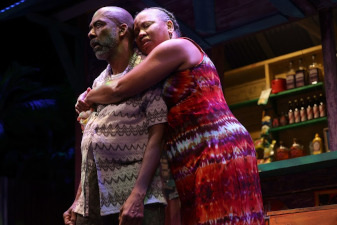
Eljon Wardally’s play “Blooming in Dry Season” is a riveting production. The play won the Silvia Sprinkle-Hamlin Rolling World Premiere Award at the 2024 International Black Theatre Festival. Directed by Jackie Alexander, the play sparkles with energy, beauty, and humor that illuminates a rich text in the lilting Caribbean lingo of Grenada. The heart of the play centers on a family conflict about duty, legacy, and individual desire. Fitz was a celebrated Calypso musician and band leader in his youth with popular success; he supports his family now with selling fruits in the market. His wife, Rose keeps the family afloat with her inheritance, a rum shack that services mostly the local fishermen. Fitz had dropped out of school to follow his Calypso dream against his father’s wishes. Rose, had started her engineering studies but dropped out when Fitz turned her head. Both carry deep regrets and resentments within but make the most of their turbulent relationship with humor and profound loyalty. Their sixteen-year-old daughter Garland, named after her father’s band name, is a gifted steel pan player in her high school band who is offered to go on tour with the most famous calypso group in the Caribbean. She is to play a solo on the steel drum for a school concert that night. Fitz strongly objects to her involvement with music because he is afraid that she will drop out of school and be seduced by fame, as he was, and lose her way. She leans on her mother for moral support. The three-directional conflict exposes not only the parents’ individual emotions of failure and loss but also exposes the economic dependency on tourism that provides no more than mere subsistence for the local population. The girl wants out, the father wants to control her, and the mother is torn between daughter and husband.
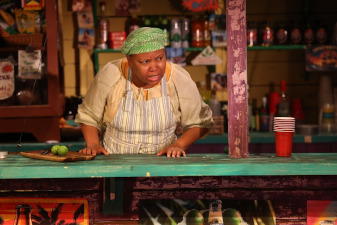
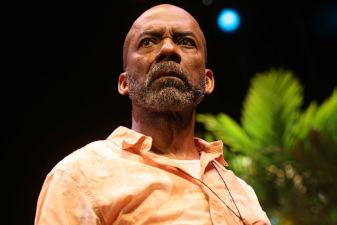
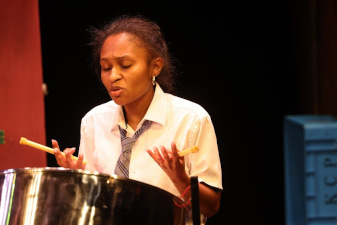
Brian Richardson as Fitz is a powerhouse. With an expressive body and voice, he projects the full range of the character’s emotions from rage to tragic collapse, from humorous “dissing” his wife to paternal intimidation. He captures with charm and frightens with barely controlled fury—there are lovely scenes of tenderness with his wife when both sing a song of their youth, and with his daughter when he teaches her to find a correct note. Melanie Matthews plays Rose, who keeps her husband with no-nonsense wit in line and manages her daughter’s frustrations with the maternal intelligence that knows how to curb volatile teenage impulses. Ms. Matthews is funny, tender, strong in body and mind, but she also reflects on the personal losses or sacrifices that are part of a woman’s existence in a patriarchal society. It is the latter experience that ultimately motivates her to help her daughter become free to choose her own path. Last not least in this family trio is the daughter, Garland, played by Nikyla Boxley with great charm and moxie. She projects the positive enthusiasm of youth while being sensitive to her parents’ struggles which she hopes to alleviate by building her dream career as a super successful steel pan player; she dreams of building them a great house. Ms. Boxley’s open expressive face and her agility are a marvelous counterpoint to her mother’s reserve and her father’s volatility.
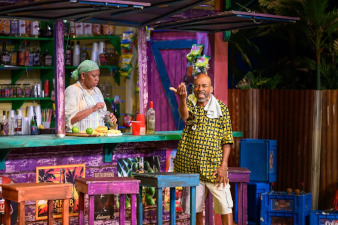
The scenic design by Isabel and Moriah Curley-Clay features a colorful realistic rum shack with corrugated tin roof, framed by palm trees and tropical greenery on both sides. Antoinette Tynes lighting design gives the feel of tropical island heat. Original Calypso music was composed by Etienne Charles, a multiple award-winning Trinidadian musician, and supported by the sound design of Lee Martinez Cruz. Costume design by Gregory J. Horton provides Ms. Matthews with a couple of lovely dresses.
Once again, Woodie King Jr.’s New Federal Theatre, now under the capable aegis of his longtime partner Elizabeth Van Dyke gives New York audiences a beautifully crafted production. It gives voice to a culture that has been very much a part of New York City for centuries but is rarely seen in such an authentic manner. |

| recordings | coupons | publications | classified |