
|
Beate Hein Bennett
Woodie King, Jr., A New York
Theatre Icon “When the darkness begins to settle in around you,
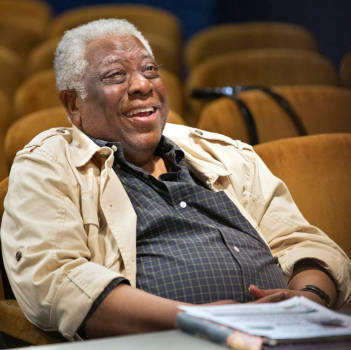
On April 27, 2026, Woodie King, Jr., the founder and long-time director/producer of the New Federal Theatre, received a spectacular theatrical celebratory ‘Good-Bye and God’s Speed’ Memorial at the Ethel Barrymore Theatre in New York’s Broadway theater district. Fittingly for a ‘king’ of African American theater, the set on stage was for the revival production of August Wilson’s “Joe Turner’s Come and Gone” directed by Debbie Allen. Ms. Allen, a Master of Ceremony at the Memorial, was a Woodie protégé as a young actress in the 1970s. Another Woodie protégé, theater director Kenny Leon, also officiated as M.C. together with Ms. Allen and Woodie’s son Geoffrey King. “Celebrating the Life and Legacy of Woodie King, Jr.,” as the Memorial was titled, brought together many American theater artists with whom Woodie had worked and, in many cases, given their professional start at the New Federal Theatre [NFT] which he founded in 1970 and which was for decades housed at the Henry Street Settlement in Lower Manhattan. Woodie had founded the theater to give voice to “people of color and women” as he specified in a 2021 New York Times interview and mentioned in the NY Times obit on Feb. 2, 2026. This meant not only actors, such as Denzel Washington, Phylicia Rashad, S. Epatha Merkerson, Samuel L. Jackson and so many others, but also playwrights. Kelundra Smith spoke at the Memorial for the playwrights Wesley Brown, Clare Coss, Laurence Holder, Diane Richards and Richard Wesley. Woodie launched Ntozake Shange, author of “For Colored Girls Who Have Considered Suicide When the Rainbow is Enuf” (NFT, 1976), and the fierce voices of Amiri Baraka and Ed Bullins to mention just a few, some of whom passed away before him. Playwright Pearl Cleage contributed an essay for the program in which she remembers Woodie giving her “the best advice I ever got as a playwright.” She quotes him: “Don’t let anyone mess with what you wrote and, if you want to be produced, no more than five characters.” She contends that “he was a playwright’s friend, filled with practical knowledge and his own artistic ideas that were always pushing you closer to your own. Your own stories. Your own dreams. Your own vision for the kind of life you might be able to build…” Her words encapsulate Woodie’s essential character and strength: absolute honesty, clarity of vision, and generosity of spirit, combined with a hands-on knowledge of the craft of theater. After all, before he became a theater artist, Woodie worked as a welder at the Ford Motor Company in his hometown of Detroit, which was in the 60s a formative hotbed of Black culture and music, much of it created and performed by artists who had been, like Woodie’s family, transplants from the South during the Great Migration. That Woodie was a down-to-earth non-nonsense character, I can confirm with a lovely personal anecdote. My companion, Moshe Yassur, a theater director, had arrived in New York City from Israel in 1970 and was looking around for a company where he might find work. He found out about the Henry Street Settlement and that the New Federal Theatre was about to establish a Jewish wing/ The Grand Street NYCHA houses had many Jewish inhabitants at the time. Moshe got an appointment with Woodie and found him in his office. Feet on his desk, Woodie said to Moshe: “I don’t have much time, I have a plane to catch for London. Can you tell me in one sentence what kind of theater you do?” Moshe answered: “I am glad you ask me for one sentence. I don’t know enough English for two sentences. I will make theater where black people, white people, yellow people come together and see the same play and will like it.” Woodie: “You got the job!” Moshe did “The Beginning,” a play by Aharon Megged, in 1971 but the Jewish wing did not last long. Even so, Woodie never forgot Moshe and many decades later, while NFT was at the All Stars Project on 543 West 42nd Street, Woodie cast and directed him as Mr. Hirsch in the play “Mr. Hirsch does not live here anymore” by Fred Neumann. It was a production of Castillo Theatre, the theater wing of All Stars. We also saw there (and in the last years, at the WP Theatre) many of Woodie's beautiful productions. He would always greet us with his bright smile and his sonorous “Mosh” is still in my ears. The roster of speakers at the “Celebration” included many well-known names: Denzel Washington, S. Epatha Merkerson, Ruben Santiago-Hudson, LaTanya Richardson Jackson and her husband Samuel L. Jackson. There were also special performances: Pauletta Washington recited the sardonic poem “Note on the Commercial Theatre” by Langston Hughes; Carol Maillard and DK Dyson from the acapella group “Sweet Honey in the Rock” performed the hymn “I found God in Myself.” Later a spectacular DK Dyson regaled the audience to “Everything Must Change” with incredible vocal and expressive force. Towards the end of the program, the Reverend Dwight Andrews gave the Benediction. Woodie King, Jr.’s legacy is now in the firm and capable hands of his life partner and fellow artist, the actress/producer Elizabeth Van Dyke. She has helped to shepherd the company through difficult times, especially in the last few years when the theater had to find new places to perform. New York’s real estate has become ever more expensive, if not downright inhospitable, to much of the non-commercial artistic community, especially the smaller theaters. (I have never understood why NYC has been so unhelpful in providing a home for significant albeit small non-profit theater institutions, such as NFT; the exceptions that come to my mind are Joseph Papp’s Public Theatre and Crystal Field’s Theater for the New City--but those were real estate gifts by the City belonging to a very different period). For several years in the aughts, the All Stars, an organization that works with inner city youth, shared its performance facilities and office space with NFT. In more recent years, the Women’s Project on the Upper West Side made room for NFT. However, at the end of the Memorial celebrating Woodie’s life and legacy, Ms. Van Dyke was able to inform the audience of the wonderful news that a permanent home is being established for NFT at 154 Christopher Street. The news brought a standing ovation with thunderous applause. And thus, a new chapter starts for this venerable institution which will, no doubt, give many more artists a home. As the audience filed out of the theater and spilled onto 47th Street, the faces gleamed, and the chatter of friends greeting each other reflected a moment of simple human joy in the privilege of having been witness to and partaken in the celebration of the life of a great human being, Woodie King, Jr. |

| recordings | coupons | publications | classified |